Sunday, July 8, 2012

PNV J18202726-2744263

4th 2012 Nova Sagittarius PNV J18202726-2744263 was discovered in Japan by Koichi Nishiyama and Fujio Kabashima as 7.8 magnitude object on July 7th. S&T sent out an AstroAlert and I was able to follow-up on it using iTelescope T20 in New Mexico. Here's a animation produced by overlaying a SERC survey image taken on 18-May-1987 . Bright star in the upper right corner is HR6842  +4.65m. 

AAVSO light curve is here.


Thursday, June 14, 2012

2012 LZ1

2012 LZ1 is a large Near-Earth asteroid (~700m in diameter) which became very bright +14 as it flew by Earth (14 moon distances) on June 14.

Here it is images using iTelescope T4 with the exposure time of just 1'. Sky motion is about 40"/min. It's flying!

     AVK00A  tC2012 06 14.40844919 38 09.11 -23 44 19.3          15.4 V      H06
     AVK00A   C2012 06 14.41071819 38 10.22 -23 42 14.1          15.4 V      H06
     AVK00A   C2012 06 14.41280119 38 10.94 -23 40 24.8          15.5 V      H06
     AVK00A   C2012 06 14.41481519 38 11.87 -23 38 34.5          15.4 V      H06


Orbit diagram is here


And here is its trail during over 5 minutes exposure during the maximum approach to Earth taken using  T16 telescope in Spain. The length of the trail is about 2.5 arc-min.


Tuesday, June 5, 2012

Venus Transit

The following SOHO animation shows Venus approaching Sun's disk during the 4 & 5th of June.

And on the following image the bright object that quickly disappears on the left is Mercury!

And this is what we saw!


Wednesday, May 23, 2012

Nova Sagittarius PNV J17452791-2305213

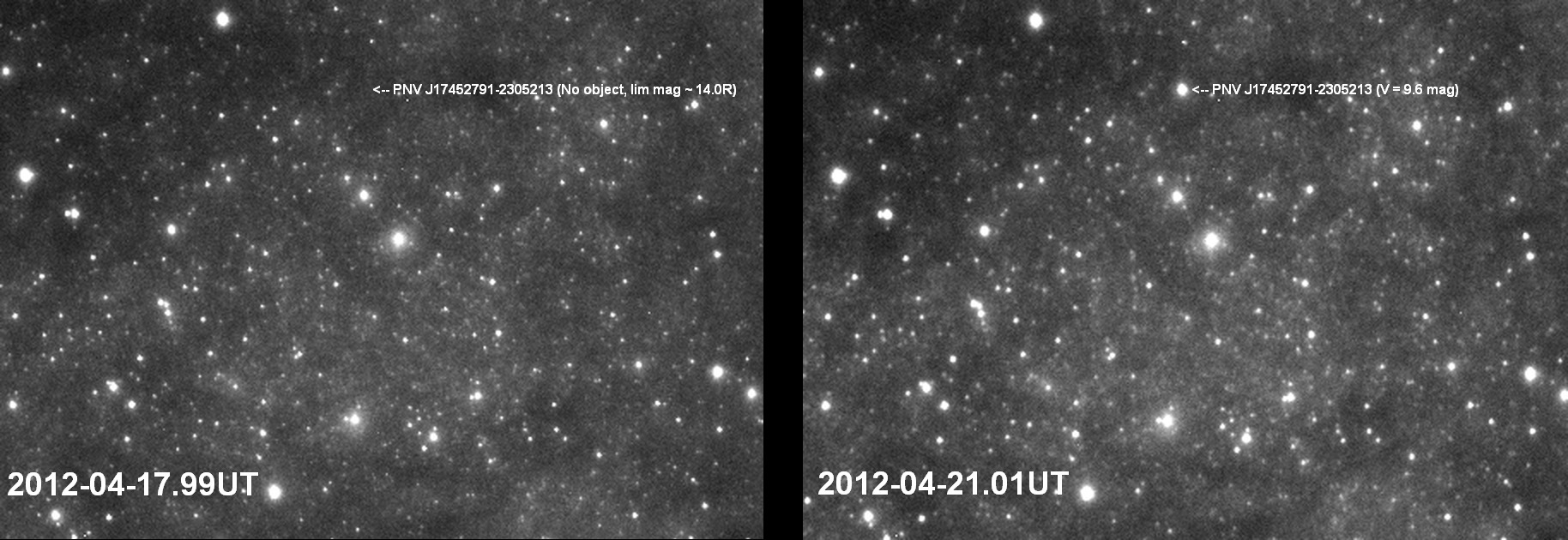
On April 21st Stanislav Korotkiy and Kirill Sokolovsky from Russia discovered magnitude +9 Nova in the constellation Sagittarius. As reported in S&T here are their discovery images.

Here's its photo taken on April 30th, when its brightness fell down to ~12m.


This nova was also detected from STEREO spacecraft 


Here are two photos taken on May 1 and May 21 2012 (click on image to zoom in)


Monday, May 21, 2012

2012 EO4 - who are you?


So where does 2012 EO4 belong in the Main Asteroid Belt? By cross-plotting the orbital elements of all asteroids in the belt one can find that they cluster in a number of families. The plots below show how 2012 EO4 compares with the rest of the population.

Apparently it belongs to Flora family based on its inclination and semi-major axis. However, the eccentricity is a bit too high (the orbit is elongated more than expected). Since it is thought that Flora family lost up to 50% of its mass through secondary collisions it is possible that 2012 EO4 is one of those "ejected" asteroids, which have very similar orbital elements with Flora, but greater eccentricities.

2012 EO4 is located close to the inner edge of the asteroid belt. It is possible that the Chicxlub impactor  was from Flora family! The composition of 2012EO4 should be similar to L-chondrite meteorites, which are thought to originate primarily from the inner asteroid belt. These meteorites are rich in olivine and orthopyroxene and have relatively low iron concentration, suggesting that the parent body was at least partially differentiated. 


Jazz Asteroids

Sunday, April 22, 2012

2012 EO4 Official Orbit


On April 22nd, 2012 MPC and JPL Small-body database published the official orbit of my asteroid. JPL has a very nice applet on their website, which allows tracking the asteroid back and forward in time.

Here is the position of 2012 EO4 on the discovery date:


MPC Ephemeris query shows that the object was first detected by 691: Steward Observatory, Kitt Peak-Spacewatch, Arizona, USA on 29 January 2012 - one month before me! But since they observed it for just one night the discovery credit will still be mine!

Interesting enough F51: Pan-STARRS 1, Haleakala, Hawaii, USA also saw the object on March 20th!