Thursday, October 10, 2013

Comet C/2012 S1 (ISON)

28 Nov 2013 Grand Finale


05 Nov 2013


06 Oct 2013


29 Sept 2013


10 Feb 2013

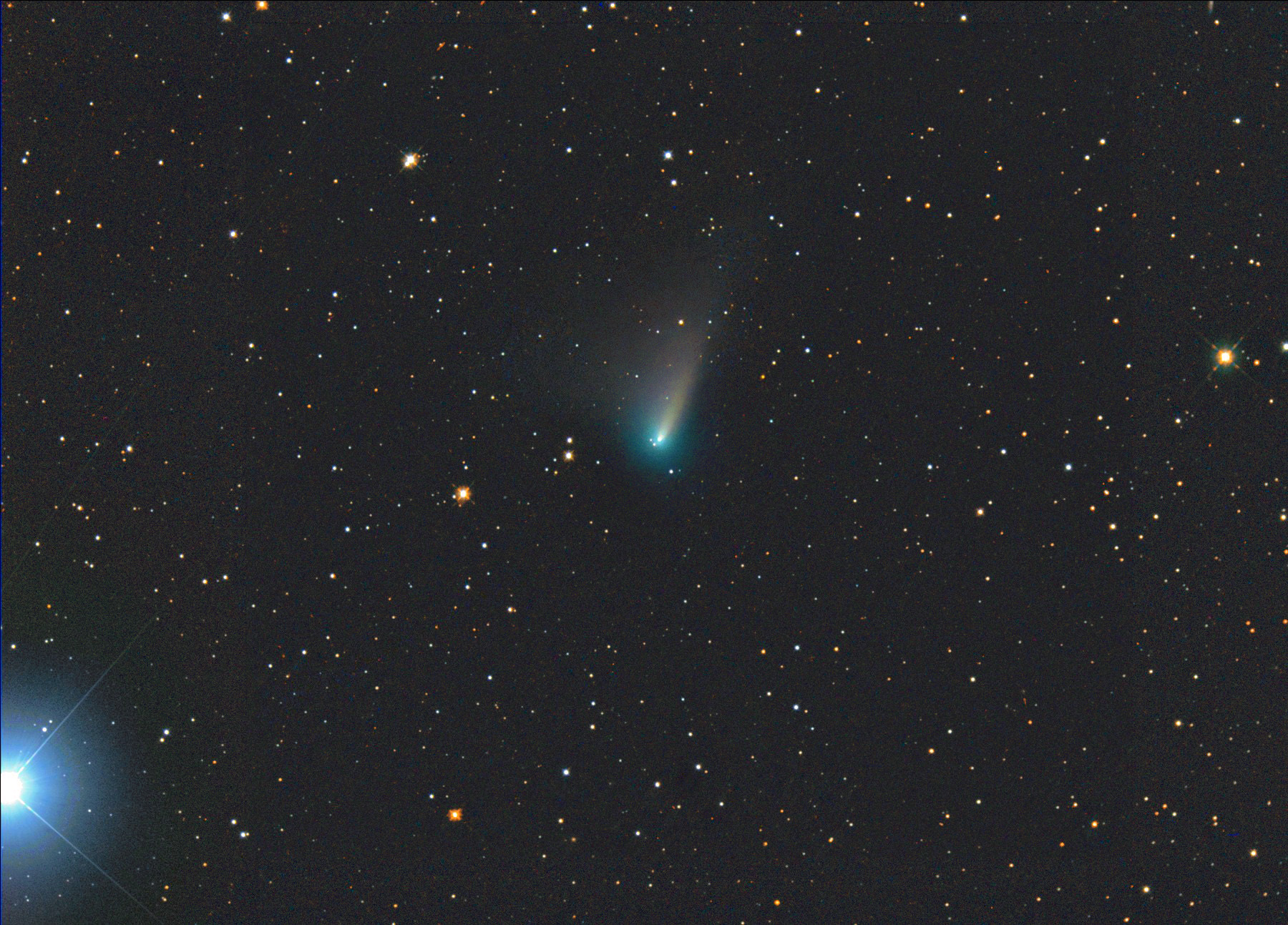
The comet photographed here in the center of the image at the magnitude of +15 shows small tail. 
Located slightly about the orbit of Jupiter at a distance of 4 AU from Earth it is projected to become extremely bright in November. Let's hope it will!


12 Dec 2012
C/2012 S1 (ISON) is expected to become one of the greatest comets of this century. Discovered by Russian astronomers Vitaly Nevsky and Artem Novichonok on September 21, 2012 as 18th magnitude object, this comet is currently approximately +16.5m and is located above the ecliptic plane roughly as far as Jupiter from Sun . This image clearly shows its non-stellar appearance.


Wednesday, October 9, 2013

C/2011 L4 (PanSTARRS)

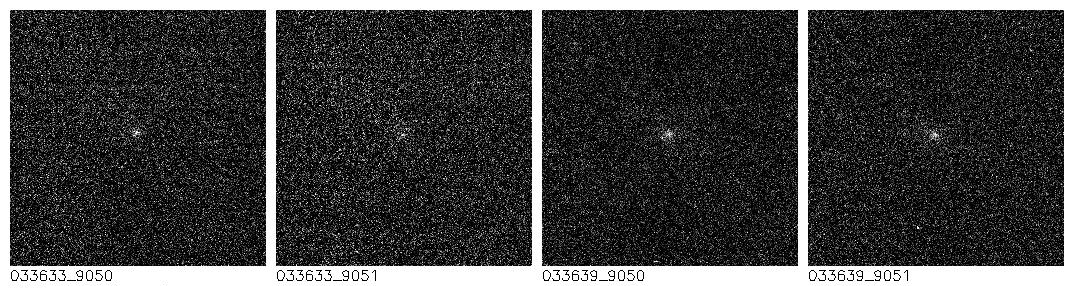
This comet discovered by PanSTARRS survey is expected to become a great magnitude 0 comet in Spring of 2013. Here I will try to follow it monthly and see how it brightens as it travels towards the Sun.
Here are the images on the discovery night (credit Credit: Henry Hsieh, PS1SC):


03/13/2013

And finally, Panstarrs is visible from my backyard!


06/23/2012

Although remotely controlled telescopes do an extremely good job, still there's nothing like capturing an image of a faint comet from your backyard! Here I used DSLR attached to my 8" SCT to capture the light of C/2011 L4 from my suburban home. It's not a pretty picture, but I had a lot of fun taking it, especially because there were not bright stars nearby and I don't have a go-to mount!


06/14/2012

Almost exactly a year since its discovery by PanSTARRS the comet is now moving between constellations of Scorpion and Libra and has reached magnitude 12. It is now 3.3 and 4.3AU away from the Earth and Sun respectively. It crossed the orbit of Jupiter in March and won't reach Mars orbit until January 2012. A small tail is clearly visible on stacked image.


Comet C/2011 L4 (PanSTARRS)


   CK11L040  C2012 06 14.22025 15 50 00.09 -25 47 03.2          14.6 N      857
   CK11L040  C2012 06 14.22882 15 49 59.45 -25 47 02.7          14.6 N      857
   CK11L040  C2012 06 14.23578 15 49 58.92 -25 47 02.1          14.6 N      857
   CK11L040  C2012 06 14.24109 15 49 58.52 -25 47 02.1          14.6 N      857
   CK11L040  C2012 06 14.24803 15 49 57.94 -25 47 01.4          14.6 N      857
   CK11L040  C2012 06 14.25266 15 49 57.63 -25 47 01.6          14.6 N      857

04/22/2012

Over the past few weeks the comet kept moving through dense star fields and crossed the border of the constellation Scorpius. Here it is easily seen as bright magnitude 15 object. The images were taken with 370mm Riegel telescope.


It is somewhere in here... (this one was actually taken with Takahashi Epsilon 250 the following night). The bright star is 25 Sco.


COD 857
OBS A. Kostin
MEA A. Kostin
TEL 0.37-m f/14 reflector + CCD
NET PPMXL
    CK11L040  C2012 04 22.40209 16 47 48.59 -25 19 10.0          15.4 N      857
    CK11L040  C2012 04 22.42293 16 47 47.71 -25 19 12.2          15.4 N      857
    CK11L040  C2012 04 22.44375 16 47 46.79 -25 19 14.3          15.4 N      857


Friday, February 15, 2013

2012 DA14


I took this photo of the Near-Earth asteroid 2012 DA14 using remotely-controlled telescope in Australia as it was rapidly approaching our planet . On this photo the asteroid is moving at 2200 arc-sec per minute through the southern constellation of Vela ("Sails"). The animation consists of three 1-minute frames taken through a 100 mm astrograph. 


Saturday, November 24, 2012

Comet C/2012 K5 (Linear)

2 Feb 2013

One month later the comet is significantly dimmer  and is now at almost 1 AU from Earth


4 Jan 2013

This photo is take near comet's closest passage with Earth at a distance of approximately 47 million kilometers. The comet is located right at the ecliptic plane almost exactly opposite the Sun and therefore its tail is pointing almost directly away from the observer.


10 Dec 2012

Comet tail is over 1' in length


Interesting to compare with a photograph by M.Jager acquired one day earlier


24 Nov 2012

A photo of this long-period comet one week after perihelion passage. The comet will be closest to Earth on December 31, 2012.


Friday, November 23, 2012

Supernovae SN2012aw in Nearby Galaxy M95

I have been following this supernova with the idea to create a time-lapse movie of its fainting, but no noticeable decrease in its magnitude in visible light occurred while M95 was visible high in the sky. In fact, according to AAVSO light curve the reduction in magnitude between the time of discovery by Paolo Fagotti and Alessandro Dimai on March 16 2012 and the last time I was able to take a good photo on May 24 was less than half of magnitude.

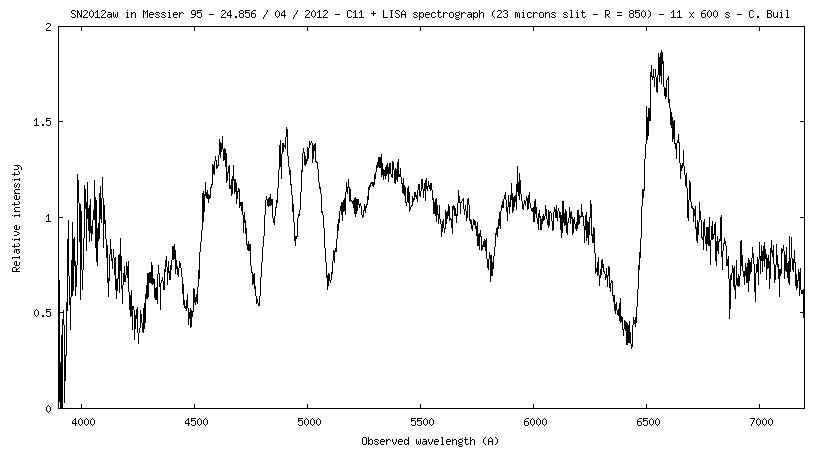
This is not surprising since the spectrum revealed that sn2012aw is a Type-II supernova 
Here's its spectrum take by Christian Buil. Notice a very prominent H-alpha emission line at 656 nm -  a clear signature of Type-II. This meas that sn2012aw will shine for a while. Type-II supernovae have a plato in luminosity  that lasts over 100 days.


After a period of invisibility, I took another photo of the Supernovae in November. Now it's noticeably dimmer.


AAVSO light curve:

Also: 

SN2012aw progenitor was found on Hubble images:


Pre-maximum discovery photo (by Associazione Astronomica Cortina).  


Sunday, July 8, 2012

PNV J18202726-2744263

4th 2012 Nova Sagittarius PNV J18202726-2744263 was discovered in Japan by Koichi Nishiyama and Fujio Kabashima as 7.8 magnitude object on July 7th. S&T sent out an AstroAlert and I was able to follow-up on it using iTelescope T20 in New Mexico. Here's a animation produced by overlaying a SERC survey image taken on 18-May-1987 . Bright star in the upper right corner is HR6842  +4.65m. 

AAVSO light curve is here.